Ebbinghaus Forgetting Curve: How We Forget and How to Remember Long Term
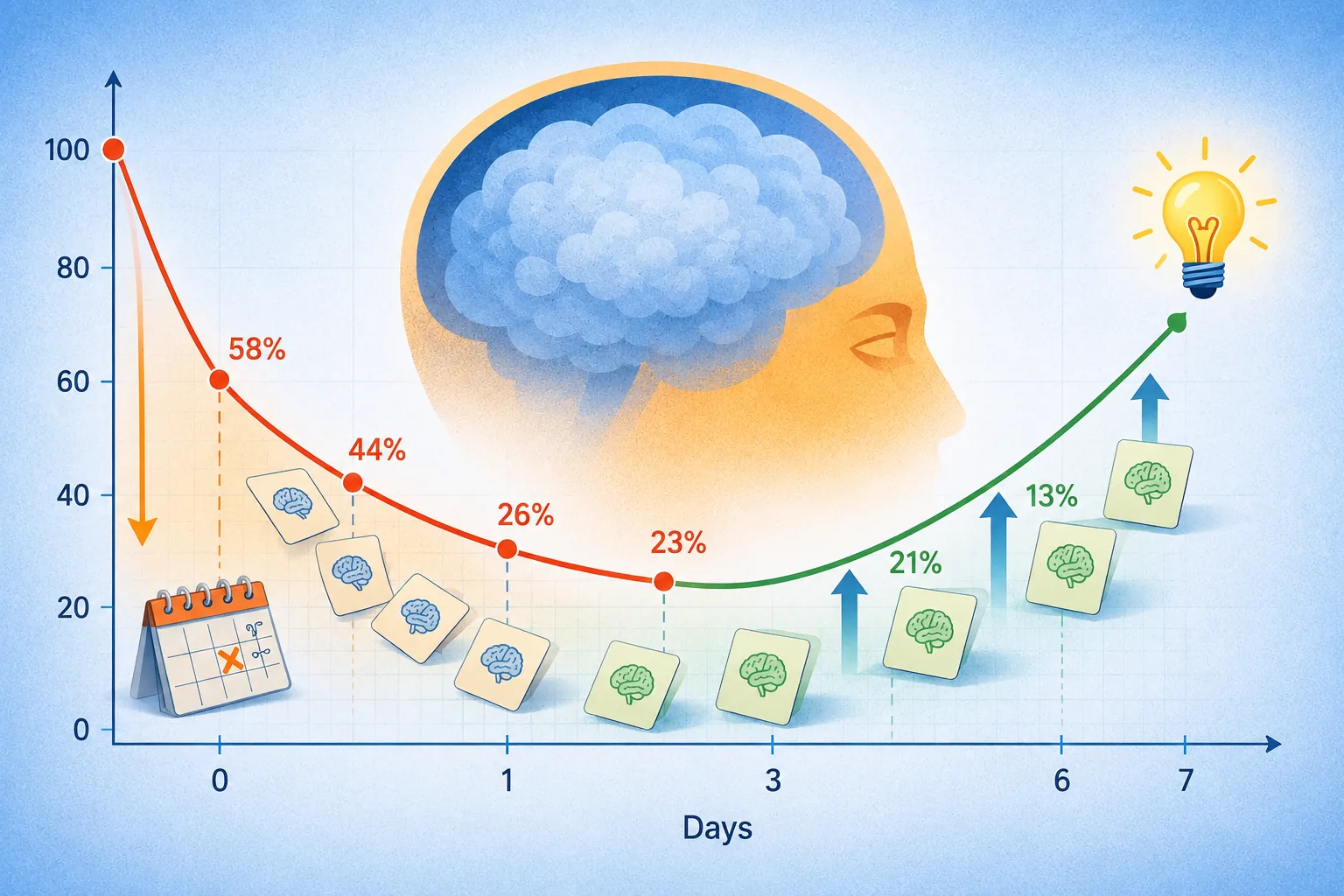
You've surely experienced this: you learned something — a word, a rule, a fact — and the next day you catch yourself thinking you barely remember anything. It's as if the information simply "evaporated".
This is not laziness, bad memory or lack of abilities.
The reason for this effect is well known in psychology and was described as early as the 19th century.
It's called Ebbinghaus Forgetting Curve.
What is the Ebbinghaus Forgetting Curve?
The forgetting curve is an empirical law showing how quickly information disappears from memory without repetition.
German psychologist Hermann Ebbinghaus conducted experiments at the end of the 19th century where he memorized meaningless syllables and measured how much information remained in memory over time.
The result proved surprisingly illustrative:
- Most of the information is forgotten in the first hours and days;
- Then the speed of forgetting slows down;
- Without repetition, memory tends to zero.
In other words:
We don't forget gradually, but in leaps and very quickly.
How does the forgetting curve look in practice?
If simplified, approximately the following happens:
- Immediately after learning — everything seems understood and memorized;
- After a few hours — only fragments remain;
- After a day — most of the information is lost;
- After a week — almost nothing remains in memory.
Important:
This is normal memory behavior, not a malfunction.
Why is our brain programmed this way?
Memory is not an archive and not a hard drive.
Its task is not to store everything indiscriminately, but to filter the important.
If information: - is not used, - is not repeated, - is not connected with other knowledge,
the brain considers it irrelevant and "frees up space".
That's why reading once or occasional repetition almost never yields lasting results.
Important conclusion from the forgetting curve
Forgetting is not the problem.
The problem is the absence of repetitions at the right moment.
Ebbinghaus showed not only what we forget, but when exactly this happens.
And this means the process can be controlled.
How to transform forgetting into a learning instrument
The good news is that the forgetting curve can be influenced.
Each repetition:
- not only refreshes the information,
- but changes the shape of the curve.
After repetition:
- forgetting slows down,
- information is retained longer,
- the next drop becomes more gradual.
Several properly distributed repetitions can transfer knowledge from short-term to long-term memory.
Why normal repetitions work poorly
The intuitive approach looks like this:
- learned → repeated immediately → repeated again → forgotten.
The problem is that:
- too frequent repetitions in a row give the illusion of knowledge;
- the brain doesn't have time to decide that the information is important;
- connections are formed weakly.
Repetitions should be done not frequently, but at the right time.
Spaced Repetitions: Ebbinghaus's Answer
From the forgetting curve directly follows the principle of spaced repetitions:
repeat information just before it starts to be forgotten.
In practice, this means:
- first repetition - after 15-20 minutes
- second repetition - after 2-4 hours
- third repetition - after 12-24 hours
- fourth repetition — after a couple of days
- fifth repetition — after a week
- and so on
Each repetition:
- strengthens neural connections,
- extends the interval until the next forgetting.
What does this have to do with learning foreign words?
Learning words is a perfect example of the forgetting curve in action.
Words:
- are not used constantly,
- are easily displaced,
- are quickly forgotten without repetitions.
If you learn words "in bulk" and then don't return to them, the forgetting curve does its job — and most of the effort is wasted.
How to apply the forgetting curve in practice
Let's examine the process step by step.
1. Learn little. A small amount of words is easier to retain and repeat in time.
2. Return to words according to intervals. Neither immediately nor too late — exactly when the word starts to "slip away".
3. Don't fear forgetting. If a word comes back with effort — it's a good sign. Precisely at this moment memory strengthens the most.
4. Increase intervals. The better a word is fixed, the less frequently it needs to be repeated.
How this works in the onemoreword app
Following intervals manually is difficult:
- it's easy to forget what and when to repeat;
- it's difficult to assess which word is already fixed and which is not.
That's why modern learning systems take on this task.
The onemoreword app follows the scientifically proven principle of spaced repetition, while intervals are chosen adaptively for each word - if you manage to quickly recall the translation of a word several times in a row, the interval increases faster, if there are errors - the app shows the word earlier and more frequently
If we continue the metaphor, the app:
- monitors the shape of your "forgetting curve",
- brings back the word precisely when it's about to disappear from memory,
- and removes it from active learning when it has become stable.
The user only has to remember — everything else the system does by itself.
Conclusion
Ebbinghaus showed a simple but important thing: Remembering — is a process, not an event.
We forget not because we learn badly, but because we don't return to information in time. When repetitions are properly organized, memory begins to work with us, not against us.
Sometimes, to remember more, it's enough not to learn more, but to learn smarter.
Frequently Asked Questions
It's a regularity showing how quickly information is forgotten without repetitions.
Because the brain filters information and deletes what is not used.
Completely — no. But it can be considerably slowed down with spaced repetitions.
Yes. Precisely for words and flashcards, the effect of the forgetting curve manifests itself especially strongly.
Ready to start learning English?
Use science-backed spaced repetition methods and learn words effectively every day