Language Proficiency Levels: What They Mean and How to Use Them
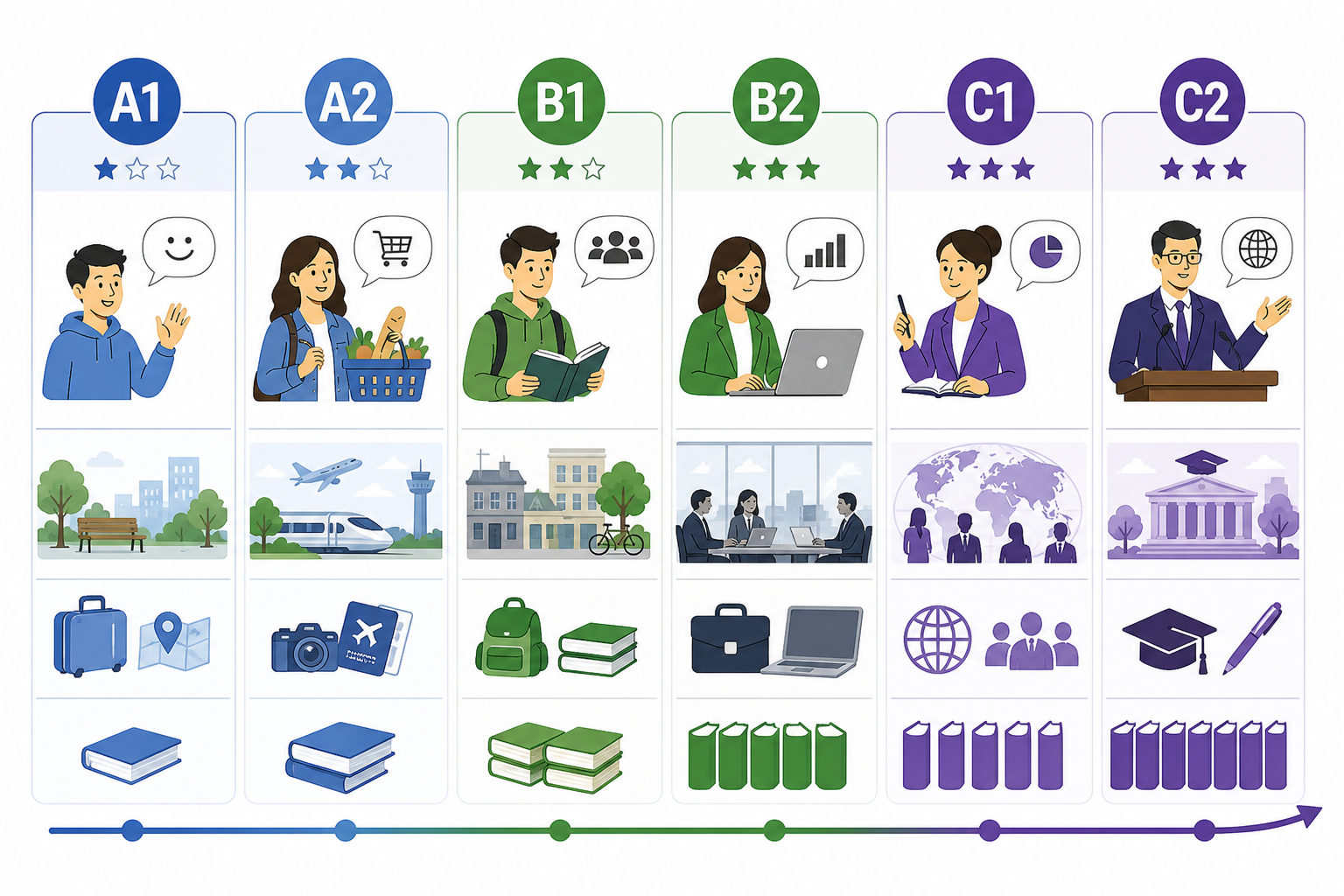
Whether you're filling out a job application, choosing a language course, or trying to understand what "B2" actually means — language proficiency levels give you a precise, universally understood way to describe how well you speak a language. This guide covers everything: the official scale from A1 to C2, what you can actually do at each level, how frameworks like CEFR and ACTFL compare, and how to list your language levels accurately on a resume.
1. What Are Language Proficiency Levels?
Language proficiency levels are a standardized scale that describes how well a person can use a foreign language — not what they've studied, but what they can actually do with it. They measure four core skills: listening, speaking, reading, and writing.
These levels matter for three practical reasons:
- Learning: They help you choose the right course materials and set realistic goals
- Hiring: Employers use them to set clear expectations for international roles
- Certification: Universities and immigration authorities require proof of a specific level
The most widely used system internationally is the CEFR (Common European Framework of Reference for Languages), developed by the Council of Europe. It defines six language levels used by language schools, employers, and exam boards worldwide.
In the US, you'll also encounter ACTFL and ILR — more on those in section 5.
2. The CEFR Scale: A1 to C2 Explained
The CEFR language levels divide proficiency into three groups of two:
| Level | Label | What you can do | Standard exam |
|---|---|---|---|
| A1 | Beginner | Basic phrases, introductions, numbers | Cambridge Starters, A1 Key |
| A2 | Elementary | Everyday situations, simple exchanges | KET / A2 Key |
| B1 | Intermediate | Familiar topics, travel, simple opinions | PET / B1 Preliminary |
| B2 | Upper-Intermediate | Complex texts, work communication, fluent exchanges | FCE / B2 First, IELTS 5.5–6.5 |
| C1 | Advanced | Academic and professional language, nuance | CAE / C1 Advanced, IELTS 7.0–8.0 |
| C2 | Mastery / Proficient | Near-native comprehension and expression | CPE / C2 Proficiency, IELTS 8.5–9.0 |
Group summary: - A = Basic User — understands and uses familiar expressions - B = Independent User — handles most situations with reasonable fluency - C = Proficient User — communicates with precision, flexibility, and depth
3. What Can You Do at Each Level?
Each CEFR level translates into concrete, real-world abilities. Here's what they actually look like in practice.
A1 Language Level — Beginner
The starting point. You can introduce yourself, ask and answer basic questions about familiar topics, understand very simple written texts, and interact in a basic way when the other person speaks slowly.
- You understand: "Where is the hotel?" "How much does it cost?"
- You can say: "My name is Sarah. I'm from London."
- Typical situation: first day of a language class, first trip abroad
A2 Language Level — Elementary
You handle routine exchanges on familiar topics: family, shopping, local geography, employment. Communication is still simple and direct, but you can manage in most everyday situations.
- You understand: short notices, simple messages
- You can say: "I'd like a table for two, please."
- Typical situation: tourist abroad, basic workplace small talk
B1 Language Level — Intermediate
The first truly functional level. You understand the main points of clear speech on familiar topics, can deal with most situations while traveling, and produce simple connected text on topics of personal interest.
- You understand: straightforward news articles, podcasts on familiar topics
- You can say: "I think working remotely has more advantages than disadvantages."
- Typical situation: travel without major language barriers, basic professional emails
B2 Language Level — Upper-Intermediate
The turning point. You understand the main ideas of complex texts, interact with native speakers without strain on either side, and produce clear, detailed writing on a range of subjects. B2 is the baseline for most international professional roles.
- You understand: TV series without subtitles, business reports
- You can do: presentations, negotiations, detailed professional correspondence
- Typical situation: working in an international team, studying abroad
C1 Language Level — Advanced
You use the language flexibly and effectively for social, academic, and professional purposes. You understand implicit meaning, humor, and register shifts. You produce well-structured, detailed text with little visible effort.
- You understand: fast native speech, academic lectures, regional accents
- You can do: argue with nuance, write high-level reports, adapt tone spontaneously
- Typical situation: senior role in a multinational, postgraduate study abroad
C2 Language Level — Mastery
The highest CEFR level. You understand virtually everything you read or hear, express yourself spontaneously with great precision, and can differentiate fine shades of meaning in complex situations.
- You understand: dialects, literary language, rapid colloquial speech
- You can do: interpret, teach, write at a literary or academic level
- Typical situation: translator, language teacher, journalist at an English-language outlet
4. Fluent vs Proficient vs Native: What's the Difference?
These terms appear constantly on resumes and job descriptions — but they mean different things to different people, and almost none of them map neatly onto the CEFR scale.
What does "intermediate" mean in language learning?
Intermediate typically corresponds to B1–B2 on the CEFR. At the lower end (B1), you handle familiar topics and basic professional situations. At the upper end (B2 / Upper-Intermediate), you communicate fluently in most real-world contexts. "Intermediate" is a broad label — always clarify which end of the range you're at.
Is intermediate better than fluent?
No — fluent is higher than intermediate. Fluency implies natural, effortless communication without significant pauses or errors that impede meaning. It maps roughly to B2–C1 on the CEFR. Intermediate is a step below: you function well in familiar situations, but complex or fast-paced conversations still require effort.
Fluent vs Proficient: what's the difference?
- Fluent (≈ B2–C1): You speak smoothly and naturally in most situations. Conversation flows without significant interruption.
- Proficient (≈ C1–C2): You use the language with accuracy, complexity, and range — not just fluently, but precisely. Proficiency implies mastery of structure and nuance, not just conversational ease.
In short: you can be fluent without being fully proficient (e.g., a B2 speaker who communicates easily but makes consistent grammatical errors). Proficiency is the higher bar.
Native vs Fluent: what's the distinction?
- Native: You acquired the language as a first language in childhood. Your comprehension, intuition, and cultural knowledge are complete and automatic.
- Fluent (non-native): You communicate at near-native level (C1–C2) but without the same unconscious mastery of idiom, register, and implicit cultural knowledge.
Quick reference table:
| Term | CEFR equivalent | What it means |
|---|---|---|
| Basic | A1–A2 | Minimal, functional in very simple situations |
| Intermediate | B1–B2 | Functional in most everyday and some professional contexts |
| Fluent | B2–C1 | Natural, effortless communication in most situations |
| Proficient | C1–C2 | Precise, flexible, complex — near-native range |
| Native / Bilingual | C2+ | Acquired as first language, or equivalent lifetime mastery |
5. CEFR vs ACTFL vs ILR: Language Frameworks Compared
If you're in the US, you've likely encountered frameworks beyond the CEFR. Here's how the three main systems compare.
| Framework | Origin | Scale | Primary use |
|---|---|---|---|
| CEFR | Council of Europe | A1–C2 | International, most language schools and exams |
| ACTFL | American organization | Novice → Distinguished | US universities, K–12 education |
| ILR | US Government | 0–5 | Federal jobs, military, diplomacy |
Approximate equivalences:
| CEFR | ACTFL | ILR |
|---|---|---|
| A1 | Novice Low–Mid | 0–0+ |
| A2 | Novice High–Intermediate Low | 1 |
| B1 | Intermediate Mid–High | 1+ |
| B2 | Advanced Low–Mid | 2–2+ |
| C1 | Advanced High–Superior | 3 |
| C2 | Distinguished | 4–5 |
Limited working proficiency is an ILR and LinkedIn term that roughly corresponds to ILR Level 2 / CEFR B2: you can handle routine work tasks in the language, but complex or specialized topics remain difficult.
6. Language Proficiency Levels on a Resume
Listing language proficiency levels on a resume is more nuanced than it looks. The wrong label — or no label at all — can disqualify you or set impossible expectations in an interview.
| Resume term | CEFR equivalent | What it signals |
|---|---|---|
| Basic knowledge | A1–A2 | Minimal — handle very simple exchanges |
| Conversational | B1 | Handle everyday conversation, not professional depth |
| Intermediate | B1–B2 | Functional in most work situations |
| Professional working proficiency | B2–C1 | Full professional use — meetings, reports, negotiations |
| Full professional proficiency | C1 | High-level professional and academic use |
| Native or bilingual proficiency | C2 / Native | Indistinguishable from a native speaker |
Best practices for language levels on a resume:
-
If you have a certificate (IELTS, TOEFL, Cambridge): list the score. It's objective and immediately credible. → English: B2 (Cambridge First — score 172/190)
-
Without a certificate: use the resume wording above with the CEFR level in parentheses. → Spanish: Professional working proficiency (C1)
-
On LinkedIn: the platform uses ILR-style labels (Elementary / Limited Working / Professional Working / Full Professional / Native or Bilingual). Match these to the CEFR table above.
-
Never overstate: recruiters often conduct interviews in the listed language. A C1 claim that falls apart in conversation is worse than an honest B2.
Frequently Asked Questions
Some simplified systems use four broad levels — Basic, Conversational, Professional, and Native — rather than the six-level CEFR scale. These map roughly to: Basic (A1–A2), Conversational/Intermediate (B1–B2), Professional (C1), and Native (C2). The CEFR's six-level scale (A1 to C2) is more precise and internationally recognized.
Fluent means you communicate naturally and smoothly with minimal hesitation — roughly B2–C1 on the CEFR. Proficient sets a higher bar: not just fluency, but accuracy, range, and the ability to handle complex, specialized, or nuanced language — C1–C2. You can be fluent without being fully proficient (e.g., you speak easily but make systematic grammatical errors).
Yes — B2 is generally considered the threshold for fluency. At B2, you communicate naturally with native speakers without strain on either side, understand complex texts, and handle professional communication in most contexts. Some definitions place fluency at C1, but B2 is the widely accepted minimum.
Limited working proficiency is an ILR Level 2 / LinkedIn term. It means you can handle routine professional tasks in the language but struggle with complex discussions, technical jargon, or fast-paced native speech. On the CEFR scale, this corresponds roughly to B2.
Use standard resume wording that matches your actual level. If you have a certified score, always lead with that — it's more credible than self-assessment. Without a certificate, use the CEFR level in parentheses for precision: French: Professional working proficiency (B2). On LinkedIn, use the platform's own scale. Most importantly: never overstate.
Ready to start learning English?
Use science-backed spaced repetition methods and learn words effectively every day