Method of Backward Planning
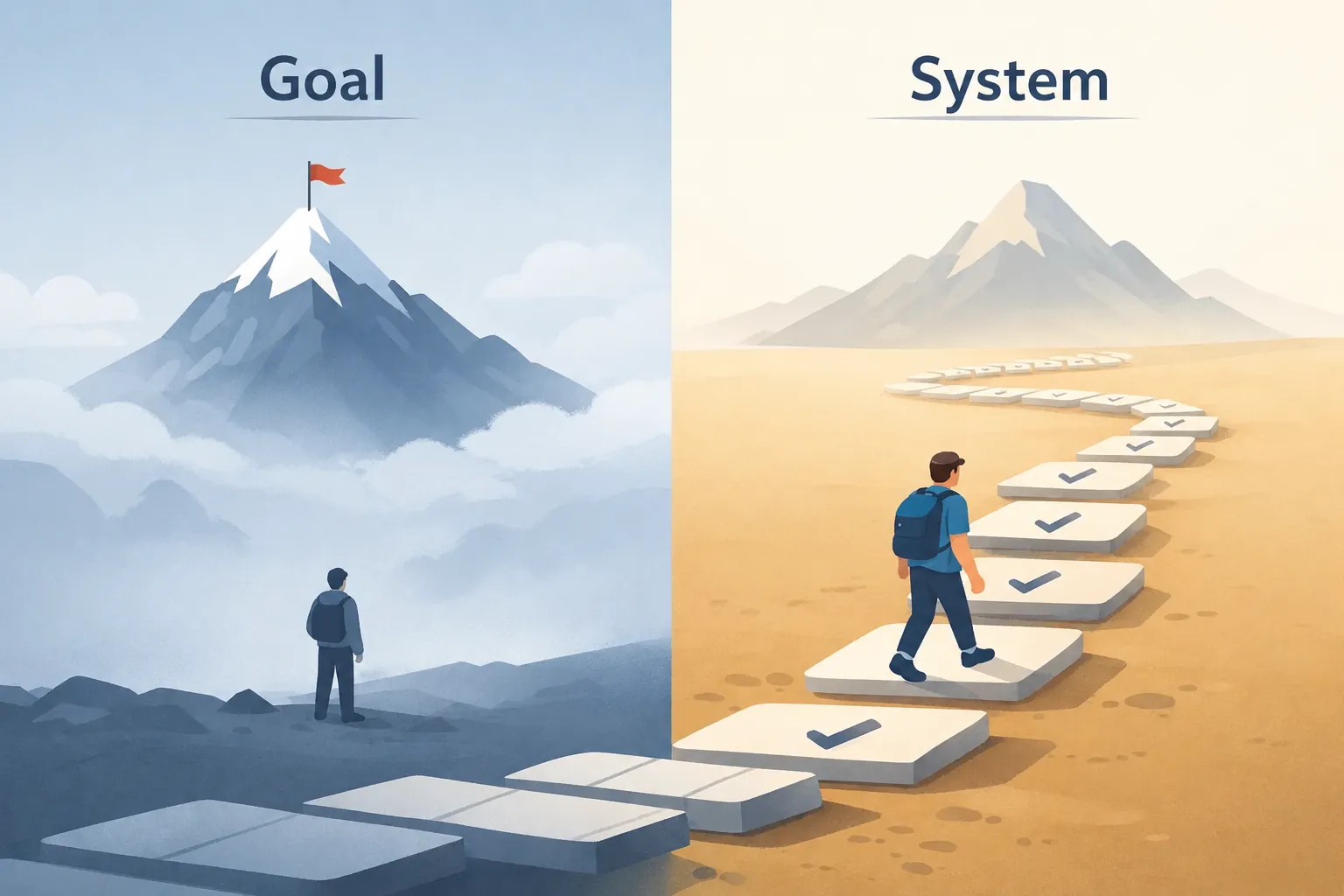
Why Classical Goal Setting Often Doesn't Work in Languages
Setting goals is very useful - they serve as a reference point that helps understand the correctness of direction.
In language learning, goals are also important. We'll discuss how to properly set goals for language learning later. But what if I told you that even a well-set goal can hinder language learning or at least not help?
The problem isn't with goals as such, but with how exactly we use them.
In languages, the goal often looks like a result without form: level, certificate, abstract "speaking fluently." And initially this works - novelty and enthusiasm pull you forward by themselves.
Problems appear later. After some time you realize the goal is still somewhere far ahead, but you are in the present. And what to do today is unclear! Generally everything is clear, but everyday decisions have to be made without orientation, the goal doesn't help with them.
What to do today? Now? Where to spend limited time? Where to start? Any choice begins to seem random because it's not yet connected with real language use.
At this moment it seems that motivation is gone, but in practice it's more often that the construction that was supposed to help move forward breaks down.
The samurai has no goal, only a path. You have a goal, but no path - this is exactly what breaks the process.
What the Method of Backward Planning Means in Simple Terms
The method of backward planning is a way to start thinking not from the current level toward the goal, but conversely, from how the end state looks.
Briefly, the essence of the method looks like this:
- Fix the end goal.
- Determine the conditions under which the goal is considered achieved.
- Ask yourself: "What should be done right before this?"
- Repeat step 3 until you reach the first concrete action that can be done today.
But don't rush to close the page, there are several important nuances without which the method won't work.
Future Image - Key Idea of Backward Planning
Looking at the 4 steps above, it's easy to combine points 1 and 2: set a goal, take a step back, repeat.
Yes, the method of backward planning starts with a goal, but the next point is much more important - the conditions that make the goal achievable. Circumstances that make the goal inevitable and meaningful. Essentially, this is an image of the desired future. And the goal is only needed for its description.
What matters is not the formulation of the result, for example "B1 certificate" but the consequence of this result personally for you.
Imagine that you have already achieved the goal. Find yourself in that moment when the goal is already fulfilled. Describe it. Who are you? Where are you? How will your life change? Immerse yourself in this image.
And now answer the question: what signs are there in your life showing that you have achieved the goal?
In the context of language learning you can ask yourself "what should already be true if the language is really being used".
- Where am I when I use the language on a typical day?
- With whom exactly do I most often speak in this language?
- At what moment during the day does the language appear by itself, without effort?
- What tasks do I solve in the language, even without noticing?
- What has become "usual routine" in this language for me?
and so on.
This is the most important point of the method, so try to really feel and describe in detail your future image after achieving the goal.
Why This Is Not the Same as Breaking Down Goals Into Steps
Breaking down goals into steps keeps the goal at the center of attention. It remains the point to which you need to come through the correct sequence of actions.
Backward planning works differently. The goal as a formulation moves to the background, and sometimes stops being needed altogether. At the center is the end state and the logic of what should be built so that the goal becomes possible and even inevitable.
Therefore, any list of steps compiled "from the end" still doesn't make the planning backward.
Why the Future Image Is Important, Not the Goal
This changes the reference point and, consequently, decisions.
Now, knowing in detail where you arrived in the future, you can build the path back to the present.
If moving from the goal, the path would look like this:
- Certificate B2
- Certificate B1
- Certificate A2
- Certificate A1
Great, there's a path, but what to do is unclear. Decomposition exists, but it's superficial.
Language levels are convenient as a scale, but poorly suited for daily navigation. They don't answer the question of what exactly happens between "not yet" and "already yes".
Focus on the process gives more feedback. Even on a plateau it becomes visible that the system continues to work, though without sharp jumps.
If you have a future image, you can build trajectories for each skill, quality and sign of achievement you need.
For example, if you see yourself as a programmer in an international IT company, then it's more important for you to write and read technical documentation, listening is more important than speaking. You immediately understand the topics you need to communicate about and don't waste your time on word lists like "vegetables and fruits".
Why the Method Works
The method of backward planning removes the main source of getting stuck in languages - the feeling of movement without real progress.
When you start from the future image, not from an abstract goal, the logic of decisions changes:
- you stop doing "useful" actions that aren't used in real life;
- you can see in advance which skills are critical and which can be postponed or not touched at all;
- you faster detect bottlenecks - where the language breaks down in real use, not in exercises.
It's also important how the method works. It doesn't give a step-by-step plan and doesn't promise quick results. Instead, it creates a framework for making daily decisions: what to learn now, where not to spend time. Measuring progress not by lessons completed, but by what tasks you can already solve in the language.
Typical Errors in Using the Method
Most often the method of backward planning doesn't work not because it "doesn't work", but because it's used formally.
- The plan is built from the goal, not from the future image. As a result, the path again reduces to levels, courses and checkmarks, not to real language use.
- The future image remains vague. "Speaking fluently" or "knowing language for work" don't give support for decisions. From such an image it's impossible to build a meaningful path back.
- The path is divided into large, formal steps. "B2 in a year → A2 in half a year → A1 in three months" creates a feeling of structure, but doesn't answer the main question - what exactly to do today and why exactly this.
- Substituting the future image with a "correct" image. People don't describe their future life, but socially approved.
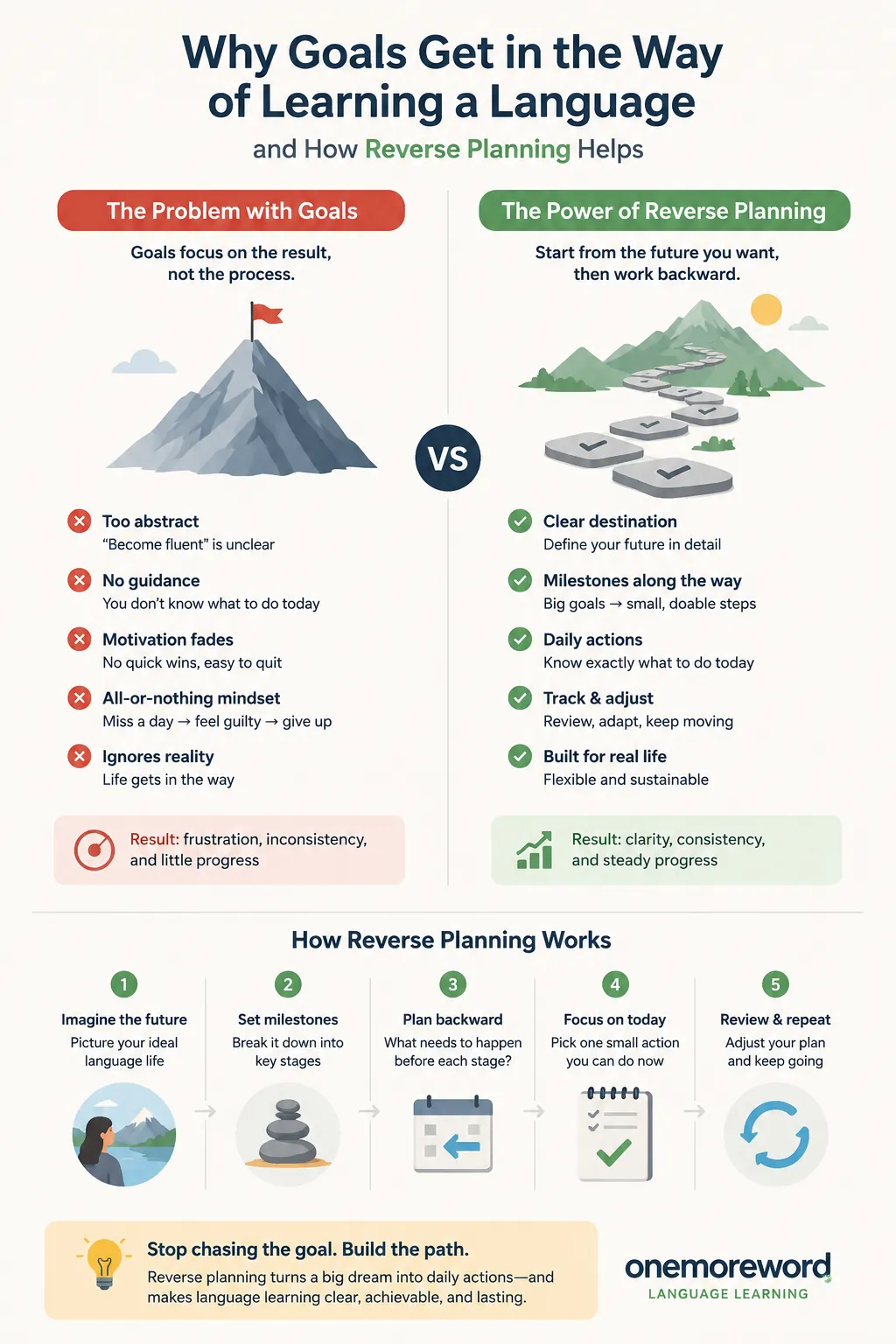
Method of Backward Planning in the Example of Language Learning
If describing the end state not as a level, but as a situation, language stops being an abstraction. It integrates into specific contexts and actions.
From this it becomes clearer what really needs to be built, and what can be postponed. Decisions are made not "because that's how everyone does it", but because without them the final picture doesn't come together.
At this moment it's especially clear that language is not a goal, but a process that needs to be maintained. Sometimes for this it's enough to have a tool that helps maintain regularity and focus on the needed elements, not on abstract levels - for example, an application for working with words and repetition as part of the learning system.
Ready to start learning English?
Use science-backed spaced repetition methods and learn words effectively every day